


Greater Dallas AFP Emerging Leaders
Watch this page for upcoming events for fundraisers age 35 and under or with 5 years or less experience. Members and non-members welcome!
Have a speaker or topic to recommend to our programs committee?
The AFP DFW Emerging Leaders Spotlight recognizes rising fundraising professionals who are making a meaningful impact on their organizations and the Dallas philanthropic community. If you know an inspiring emerging leader who deserves to be featured, please email .
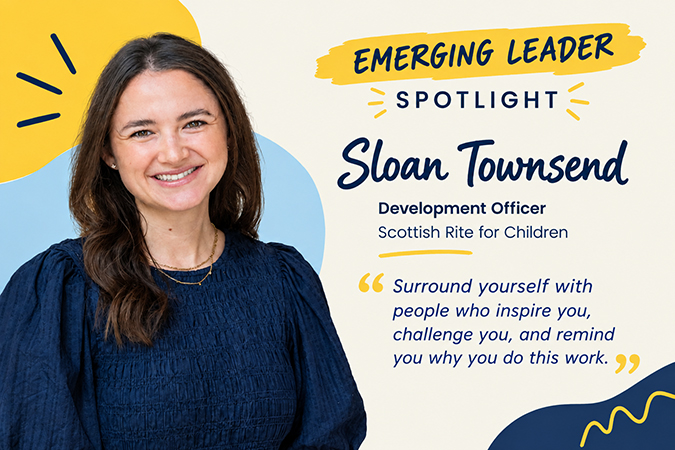
This month we're highlighting Sloan Townsend. Sloan is a Development Officer at Scottish Rite for Children, where she works to build relationships that connect supporters to the hospital's mission. After discovering Scottish Rite shortly after college, Sloan knew she wanted to be part of the organization and worked her way from a temporary role to Executive Assistant for Development before stepping into her current position.
Sloan is also passionate about engaging young professionals in philanthropy. Through Scottish Rite's Crayon Club, she helps create opportunities for young professionals to connect with the hospital, learn about its mission, and begin building a lifelong relationship with philanthropy.
Q: How did you get started in fundraising, and what led you there?
A: For me, it was less about wanting to get into fundraising and more about wanting to work at Scottish Rite for Children. I found Scottish Rite after college, went on a tour, and immediately fell in love with the mission, the people, and the patients. I knew I wanted to be here, so I spent the summer applying for everything I could until I landed a position in the Development Department.
I started in a temporary role, then became an Executive Assistant for Development for about a year and a half before moving into my current role as a Development Officer. I studied business in college and knew I wanted to work on the administrative side of an organization, with an interest in development, events, and communications. I'm really happy that it ended up being development.
Q: When and why did you decide to become an AFP member?
A: It felt like the right thing to do. AFP seemed like the best place to go for networking, insight, and advice. My manager, who has been an AFP member for a long time, suggested that I join, and I'm so glad she did.
It's been incredibly helpful, especially as a newer fundraiser.
Q: How has being an AFP member—and participating in Emerging Leaders—benefited your career?
A: Beyond meeting great people, AFP has given me so many opportunities to learn. I've attended luncheons and educational programs on topics like ethics, fundraising, planned giving, and grant writing, as well as Emerging Leaders events and happy hours.
It's been a great way to build a network, but also to learn from people who have been in the business for many years. As someone early in my career, being able to learn from people with that experience has been incredibly valuable.
Q: Are you doing anything innovative at your organization that you think other fundraisers could learn from?
A: One thing that really excites me is our Young Professionals group, Crayon Club. At Scottish Rite, we need to build relationships and bring new friends into the organization, and we've been working to make the group engaging, interactive, and connected.
We're growing membership, working on corporate memberships, and holding multiple events each year that bring new people to the hospital. One of the things I love most is making philanthropy feel accessible to young professionals.
It can be daunting to be in your 20s and think, "I don't have thousands of dollars to give, so I can't really be philanthropic." But you can participate in philanthropy in some capacity. Crayon Club gives young professionals a fun and accessible way to support the mission, practice philanthropy, and feel like they're part of something bigger than themselves.
We're also able to bring people onto our campus through educational programs, hospital tours, and opportunities to hear directly from members of our team. It's a great way to introduce people to the mission and begin building that connection early.
Q: What professional accomplishment are you most proud of, and why?
A: Being at Scottish Rite for Children. There's truly no place I'd rather be or anything I'd rather be doing. It's a very tight-knit organization, and I have amazing mentors and leaders here to learn from.
Getting to call this place home is probably my proudest accomplishment.
Q: What do you think is the biggest challenge facing the fundraising profession today?
A: I think it all boils down to saturation. There are so many great organizations and causes to choose from. If you care about something, there's probably a nonprofit you can support.
In the DFW area alone, there are thousands of nonprofits doing incredible work. So while nonprofits aren't necessarily competing with one another, we are competing for donors' attention and philanthropic dollars. Finding ways to stand out and connect with people is a huge challenge.
Q: What's one lesson you've learned early in your fundraising career that you wish someone had told you when you started?
A: The answer is always no if you don't ask.
It's our job as fundraisers to ask. What I've learned is that people want you to ask. They want you to be specific, tell them what you need, and give them an opportunity to feel needed.
I've also learned that "not yet" can be encouraging. That mindset motivates me to take risks, ask the question, and remember that the worst someone can do is say no.
Q: What advice would you give to other emerging leaders in fundraising?
A: Join AFP—or find an organization where you can meet people and learn from others. The educational programs and networking opportunities are incredibly valuable.
I'd also say yes to opportunities. Say yes at work, in professional settings, and when it comes to networking. You never know where an opportunity might lead.
And finally, find a good mentor. Look for someone whose work you admire and whose relationships and professional approach you respect. Having someone you can learn from and use as an example can make a huge difference early in your career.
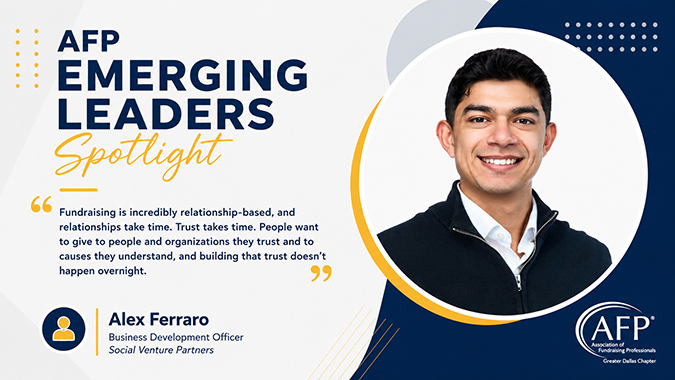
This month, we're highlighting Alex Ferraro of Social Venture Partners. His path into fundraising began with a passion for philanthropy, including establishing The Ferraro Foundation through a donor-advised fund at The Dallas Foundation and connecting nonprofits with resources through his personal network. What started as a passion project eventually led him to a career in social impact, where he now works with Social Venture Partners. As a new fundraising professional, Alex has turned to AFP to build his fundraising skills, learn best practices, and connect with experienced professionals in the field. He also values AFP's opportunities for professional development, leadership, and connection with others in the profession. He has also been a part of the AFP mentorship program.
Q: How did you get started in the fundraising profession, and what led you there?
A: I actually wanted to start a nonprofit when I moved to Dallas after college, but someone encouraged me to first get my feet under me as a young professional and do my philanthropy in my spare time. I started my career in revenue retention in the corporate world and did that for four years.
In the meantime, I wanted to contribute more to the nonprofit space, so I started a donor-advised fund at The Dallas Foundation and used it as a fundraising vehicle. I became a sort of middleman between nonprofits and potential donors in my network of friends, family, and coworkers. I naturally started fundraising in my spare time — meeting with nonprofit leaders, visiting organizations, and learning about the sector.
After proving to myself that I could be successful at it part-time, I asked my current employer if they needed someone who could fundraise. I was fortunate that they were willing to take a chance on me, and I've now been in the profession for a little over a year.
Q: When and why did you decide to become an AFP member?
A: I joined AFP in 2024 because I wanted to build a foundation of skills and learn best practices from people who had been doing this for a long time. I came to fundraising somewhat instinctively and because I was passionate about it, but I knew that real expertise and a strong skill set were important to doing the work ethically and effectively.
Getting involved with AFP felt like a natural next step. I wanted to surround myself with professional fundraisers who could teach me, answer questions, and point me in the right direction. I also wanted to build credibility as I transitioned into fundraising professionally and work towards my CFRE.
Q: How has being an AFP member — and participating in AFP affinity groups — benefited your career?
A: Being part of AFP has given me the opportunity to surround myself with experienced fundraisers and learn from their knowledge. Having a mentor through AFP was a particularly valuable experience. My assigned mentor, Stuart Williams, and I are still in touch, and he continues to give me guidance about what might be next for me and how I can continue developing my skill set.
There is so much knowledge in the profession, and having people you can ask questions of and learn from has been a real positive for me.
Q: Are you doing anything innovative at your organization (or have you at a previous organization) that you think other fundraisers could learn from?
A: The most innovative thing I've done personally is probably the way I used my donor-advised fund. Donor-advised funds are typically associated with long-time, experienced donors, but I used mine as a fundraising vehicle to capture funds while being connected to a local community foundation that could help guide me.
That experience also shaped a philosophy that has stuck with me: everyone is a potential donor. Someone might be a coworker or former colleague who has never shown an interest in nonprofits, but that doesn't mean they aren't interested in supporting a compelling cause. Sometimes they simply haven't been introduced to the right opportunity.
There is a saying in fundraising that the number one reason people don't give is because they aren't asked. I think that's closely connected to the idea that everyone is a potential donor — they just may not be aware of the opportunity.
Q: What professional accomplishment are you most proud of and why?
A: I'm most proud to be part of the team at Social Venture Partners. I get to work with my former CEO, Tony Fleo, who is a transformational leader, and my current CEO, Catherine Cuellar, who is a well-known professional and leader in Dallas.
Being part of a mission-focused team is an honor. It's a different energy when everyone is there to advance a mission and bring their talents to something they genuinely care about.
That's probably what I'm most proud of — being part of a team like that.
Q: What do you think is the biggest challenge facing the fundraising profession today?
A: From my relatively short experience, I'd say that fundraising itself is incredibly challenging. Fundraisers are asking people to spend discretionary dollars in an economy that feels tight for many people, so convincing someone to give can be difficult.
Donors are also increasingly thoughtful about their budgets and want to know whether their gift is the best investment they can make in terms of impact. Experienced donors are savvy, and for good reason, but they also seem to be more conscious of their budgets than they may have been in the past.
Q: What's one lesson you've learned early in your fundraising career that you wish someone had told you when you started?
A: Fundraising is incredibly relationship-based, and relationships take time. Trust takes time. People want to give to people and organizations they trust and to causes they understand, and building that trust doesn't happen overnight.
For young fundraising professionals, I'd encourage them to take the pressure off themselves. If you're new to an organization, you don't necessarily need to convince someone to write a huge check in your first quarter. That's not a reasonable expectation in most cases.
I've found it comforting to remember that building relationships and earning trust takes time. Be patient with yourself and let those relationships develop.
Q: What advice would you give to other emerging leaders in fundraising?
A: Be patient, ask a lot of questions, and seek out as many mentors as you can handle. There is so much experience and wisdom among seasoned fundraising professionals, and there is no substitute for that experience.
If you have an experienced fundraising team around you, take advantage of that knowledge. Ask questions, seek guidance, and learn from the people who have been doing this longer than you. If you don't have that support within your organization, look for it outside of your organization.
The AFP DFW Emerging Leaders Spotlight recognizes rising fundraising professionals who are making a meaningful impact on their organizations and the Dallas philanthropic community. If you know an inspiring emerging leader who deserves to be featured, please email .
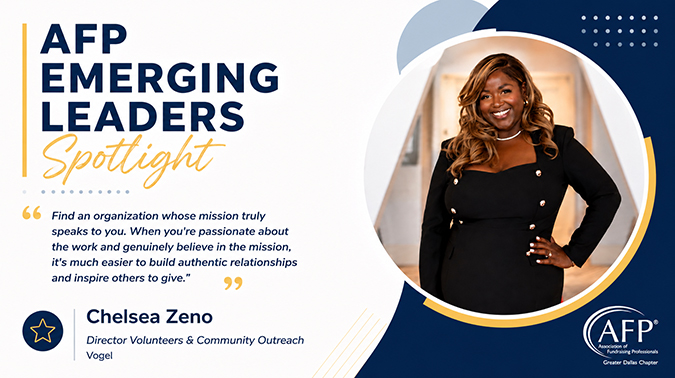
This month, we're highlighting Chelsea Zeno of Vogel Alcove. Since joining the organization's Development team last year, Chelsea has excelled in Volunteer and Community Engagement, building meaningful relationships with volunteers and championing Vogel Alcove's mission. Drawing on her previous experience as a leader on Vogel's Family Support team, she brings a unique perspective to fundraising and community engagement. Recently becoming a provisional member of the Junior League of Dallas, Chelsea continues to invest in her professional growth while inspiring others through her generosity, enthusiasm, and dedication to serving children and families.
Q: How did you get started in the fundraising profession, and what led you there?
A: I began my career in education as a teacher with Head Start, where I quickly realized that supporting a nonprofit involved more than teaching. I found myself building community relationships and helping raise resources for the organization, which sparked my interest in fundraising.
From there, I joined Big Brothers Big Sisters, where I focused on volunteer management and developed a partnership with the Boys & Girls Club in my hometown of Lafayette, Louisiana. Seeing that partnership continue to grow, and still exist today is incredibly rewarding. When I moved to Dallas, Vogel Alcove felt like the perfect fit because it combined my passion for education with serving children and families. After spending several years supporting parents through education and workforce development programs, I transitioned into development, where I now focus on building relationships that help advance Vogel's mission.
Q: When and why did you decide to become an AFP member?
A: I became an AFP member last year after being encouraged by my colleague Susan Read. She spoke highly of AFP and how it helps fundraising professionals grow their careers. Since I didn't study fundraising in school, I saw it as a great opportunity to continue learning from others in the profession.
Q: How has being an AFP member — and participating in AFP affinity groups — benefited your career?
A: AFP has provided valuable opportunities to learn from experienced fundraising professionals and expand my knowledge of the field. Being part of a professional community has helped me continue developing my skills and build relationships with others who are passionate about nonprofit work.
Q: Are you doing anything innovative at your organization (or have you at a previous organization) that you think other fundraisers could learn from?
A: One area I'm passionate about is helping organizations recognize the value of volunteer engagement. Volunteers don't just give their time — they can also help generate financial support through corporate volunteer grant programs and other workplace giving initiatives.
Creating meaningful volunteer experiences encourages people to stay involved, deepen their connection to the mission, and often leads to additional support for the organization. Finding ways to turn volunteer hours into financial impact is something I believe more nonprofits should prioritize.
Q: What professional accomplishment are you most proud of and why?
A: One accomplishment I'm especially proud of is creating Vogel Alcove's Professional You program. As one of the founders of the program, I helped develop the curriculum for this 12-week workforce development program, which supports parents who were unemployed or not enrolled in school.
The program helped approximately 50 parents either secure employment or return to school. Vogel later adopted it as a permanent career services program, and it continues to serve families today. Seeing an idea grow into a career pathway program has been incredibly rewarding.
Q: What do you think is the biggest challenge facing the fundraising profession today?
A: There are a lot of different organizations competing for the same dollars, but fundraising isn't about selling — it's about building genuine relationships. While every organization has fundraising goals to meet, it's important not to lose sight of the people behind each gift.
Taking the time to understand a donor's interests, build trust, and create lasting partnerships leads to more sustainable support than focusing only on immediate fundraising goals.
Q: What's one lesson you've learned early in your fundraising career that you wish someone had told you when you started?
A: Every conversation can lead to an opportunity. I learned that it's important to approach each interaction with intention, knowing what you're hoping to accomplish while remaining open to building authentic relationships.
Those conversations often lead to partnerships, mentorship, and future opportunities you may not have expected.
Q: What advice would you give to other emerging leaders in fundraising?
A: Find an organization whose mission truly speaks to you. When you're passionate about the work and genuinely believe in the mission, it's much easier to build authentic relationships and inspire others to give.
Leading with your heart creates stronger connections with donors, volunteers, and the community, and ultimately leads to greater impact.


